Centre for the Study of Social Inequality (CSSI)

My colleague, Shannon Ang, and I have set up a research centre at Nanyang Technological University (NTU). The Centre for the Study of Social Inequality (CSSI) aims to:

(1) promote and enhance multi-disciplinary understandings of inequality’s various forms and dynamics;

(2) nurture public social science–attentive to the concerns of ordinary members of society, deliberate in making links between theoretical knowledge and practical solutions, and committed to making academic knowledge accessible to a broad public.

More about our mission here, and how the Centre came about here.
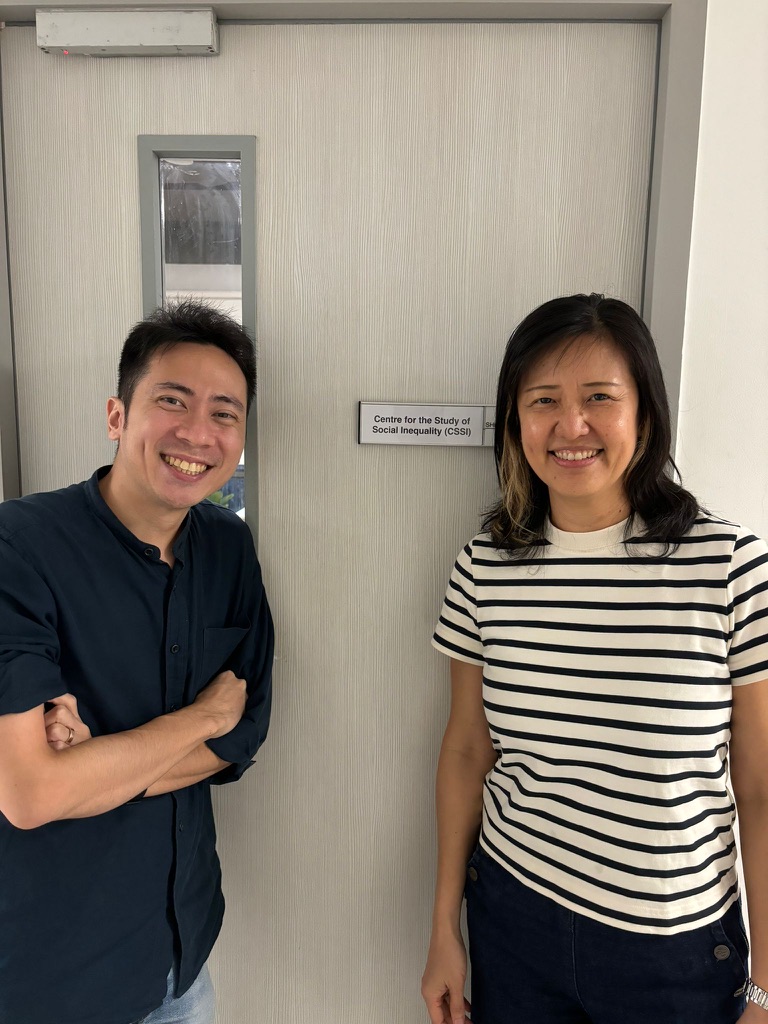
It is early days and we have much to do. We’ve begun the work of building up networks amongst scholars, across various universities in Singapore and from multiple disciplines; we’re pleased that many colleagues have agreed to be centre Associates. We aim to support younger scholars interested in pursuing the study of inequality in Singapore and are also happy to have granted our first Junior Visiting Fellowship. In May 2025, we will co-host the Population Association of Singapore’s (PAS) Annual Meeting, with the theme of “Demography and Inequality: Intersecting Paths.”
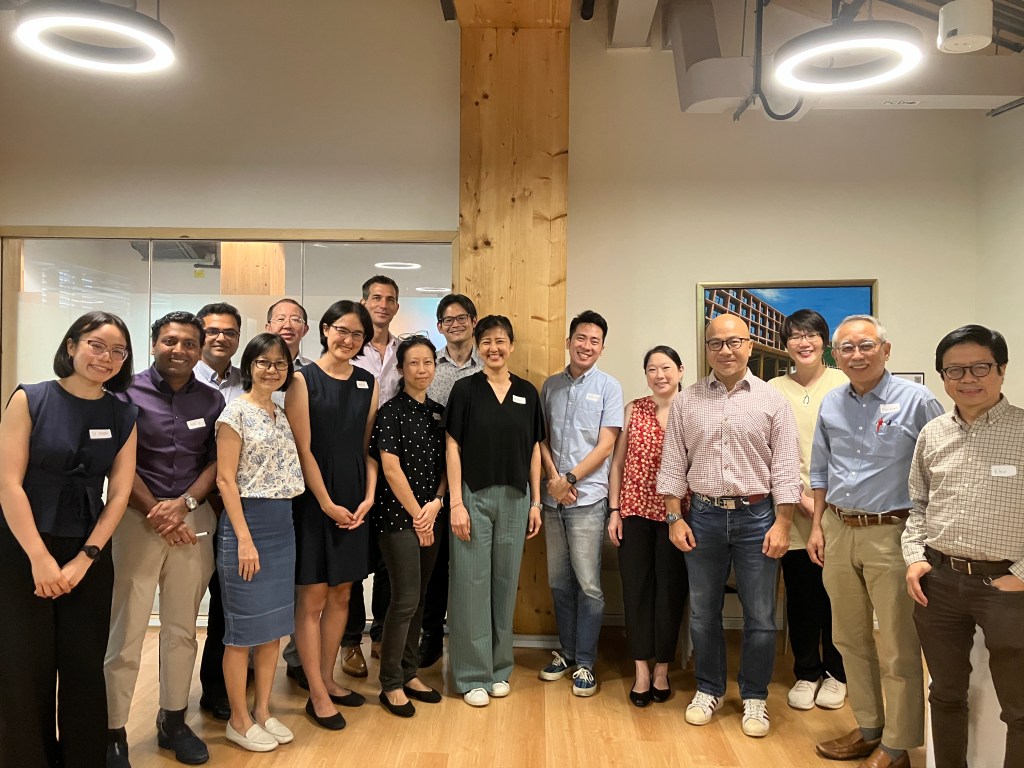
Networking lunch with some Advisory Board members and Associates, February 2025

The founding of a centre for the study of social inequality, unimaginable just a few years ago, speaks to changes that have already occurred in our society’s collective commitment to inequality as a problem. We believe research and knowledge are crucial for further generating ideas for solutions and for continuing to energise society’s collective response to an urgent social problem. We hope colleagues, collaborators, allies, and fellow members of Singapore society will agree.
Beyond CSR, annual days of service, and philanthropy: community and its virtues

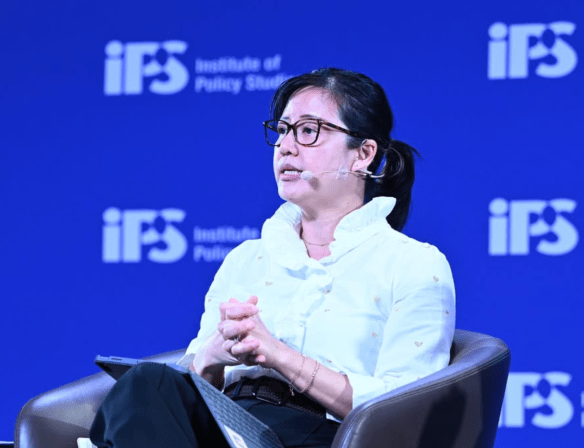
I was invited to speak on a panel on ‘Community and the Market’ at the Institute of Policy Studies (IPS) Singapore Perspectives 2025 conference on the theme of ‘Community.’

We use ‘community’ a lot, positively, but often as mere rhetorical flourish. In my remarks, I explored why we value community and what virtues it embodies. I argued that if corporations are serious about caring about community, then abiding by its virtues–interdependence, mutuality, solidarity, collective wellbeing, and egalitarianism–must be part of everyday practices and not just peripheral and relegated to occasional volunteer or charitable activities.

More generally, all of us as members of society have the right to ask of business: how do workplace rules and regulations contribute to or harm the pursuit of the virtue of egalitarianism, in which people are recognized as human equals? To what extent do the wages workers are paid recognize their contributions to creating the results which can only be created by their collective labor? Does a corporation have space for workers to have voice in decisions that shape their collective wellbeing? Do what corporations produce by way of goods, services, technologies, ideas, information contribute to or harm the possibilities of cultivating solidarity and egalitarianism among people? Do firms relate to society in ways that recognize the importance of mutual obligations among social actors, including those of contributing to the commons through paying taxes?

Full text of speech here

Reflections: on others’ work and my own

The past few months have offered rich opportunities for reflection:

  • I commented on Professor Chua Beng Huat’s new book, Public Subsidy, Private Accumulation at the Asia Research Institute on May 2, 2024.
  • AcademiaSG held our first in-person conference on May 6-7, 2024. The artists, academics, journalists, and activists who presented were extraordinary–knowledgeable, nuanced, humorous, reflexive. After two days listening to their presentations, I gave these closing remarks.
  • The most challenging writing I’ve had to do in recent times (possibly ever) is a personal essay about my journey as a sociologist, How I’ve managed to stay an academic (thus far). I was encouraged to keep writing by the fact that I was in the marvelous company of Linda Lim, Kevin Tan, Mark Baildon, and Cherian George. The essay is a part of a series we call Occupational Hazards. I did not say much about this in my essay but AcademiaSG–the collective, our shared and evolving vision and project–has been one of the most fulfilling things in my journey.
  • Finally, thanks to the fearless and indefatigable feminists, Kanwaljit Soin and Margaret Thomas, who invited me to contribute thoughts about Singapore’s future in Why Not?: Thinking about Singapore’s Tomorrow, I was able to pause to reflect on what I’ve learnt from the numerous people I’ve interviewed over the years. The chapter that resulted is Ordinary People Dream (which World Scientific has kindly made accessible for download; Jom also generously published an excerpt).

 Household budgets in a time of rising costs 

In October 2023, the Minimum Income Standard (MIS) team launched our third report, to update prices and budgets for older person households as well as households of single and partnered parents and their children. We also compared these budgets to real incomes, and to various public schemes.

The launch event was held at the Lee Kuan Yew School of Public Policy (NUS), and reported in various news media. The reception of the report by members of the public continues to encourage us and help us think about what lessons we can draw from doing this work. We wrote a commentary to consider how MIS can help deepen views about social inclusion–what it is, and how to forge paths toward it.

Over the years, we have built up a collection of podcasts and videos, in which we talk about how we have done the research and what we have found. These are now collected on our website and we hope they allow more to be able to access our research. There is a nifty calculator for people to figure out what their own households need to meet basic standards of living. We also continue to think about the concept of a living wage and hope that others will join us in thinking about how, having established a baseline, we can work towards ensuring that no one falls below it.

Inequality and social good

Co-organized by the Economic Society of Singapore and Singapore University of Social Sciences, and in support of ‘ForwardSG,’ the Singapore Economic Policy Forum 2022 centered on the theme of social good. I spoke on what ordinary people need to lead flourishing lives, the unequal wage work and care conditions people face as they try to meet needs, and the culture of individual hustle these conditions generate. The edited text of my speech is published at AcademiaSG.

Minimum Income Standard (MIS) in the media

Ng Kok Hoe and I have been discussing our Minimum Income Standard (MIS) research on various platforms. Earlier this year, The Karyawan, a publication of the Association of Muslim Professionals, published our piece on “How people think about basic needs.” The Singapore Institute of Directors also invited us to share our research and we wrote a piece, “A living wage for Singapore” for their SID Directors Bulletin. We also had a conversation with Kwan Jin Yao, including detailed exchanges about methodology, on his SocialService.sg podcast. In May, Grace Ho, host of The Straits Times‘ newish podcast “In Your Opinion,” invited us to talk about our main findings, our responses to critiques, and reflections on current policy. The interview was aired in two parts, Part 1 on May 13 and Part 2 on May 27.

New article: “Education as care labor: expanding our lens on the work-life balance problem”

Teo, Youyenn. 2022. “Education as care labor: Expanding our lens on the work-life balance problem.” Current Sociology 0(0):00113921211072577.

(Update: published in 2023 in Vol. 71 Issue 7 Pages 1181-1382)

Abstract

Scholars have documented the challenges of combining wage work and care responsibilities in various societal contexts. National variations reveal that public policy and care infrastructure have major effects in shaping gendered patterns, class inequalities, as well as overall wellbeing of parents. Childcare centers and schools can enable people with children to pursue jobs and careers. Yet, as I show in this article, education systems’ demands can become a major component of parental care labor. Drawing on interviews with 92 parents in Singapore, I illustrate the ways in which education care labor impedes work-life reconciliation as well as deepens the significance of gender and class.

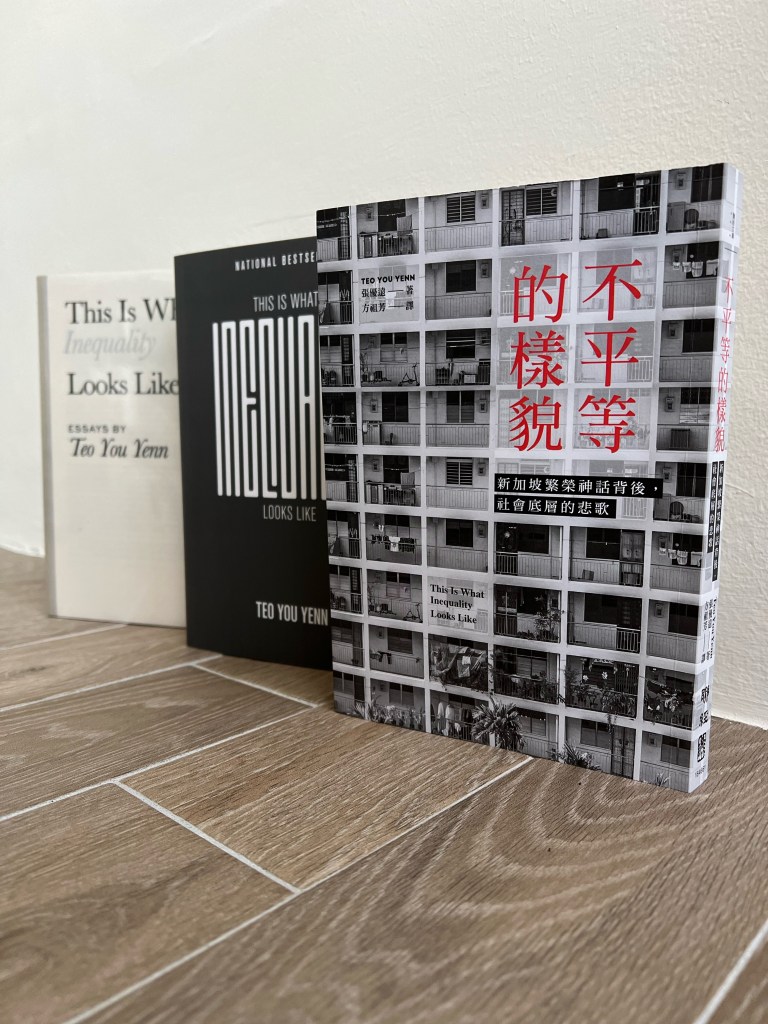
《不平等的样貌》Chinese edition of This is What Inequality Looks Like

The Chinese edition of This is What Inequality Looks Like has been published by Taiwanese publisher Linking Publishing 联经出版. It was meticulously and thoughtfully translated by translator 方祖芳 and includes a generous introduction by Associate Professor Ke-hsien Huang 黄克先 of National Taiwan University. I’m immensely grateful for their labor and pleased to have this opportunity to reach more readers.

Readers in Singapore may also purchase it at Kinokuniya and Grassroots Book Room.

New Minimum Income Standard report released

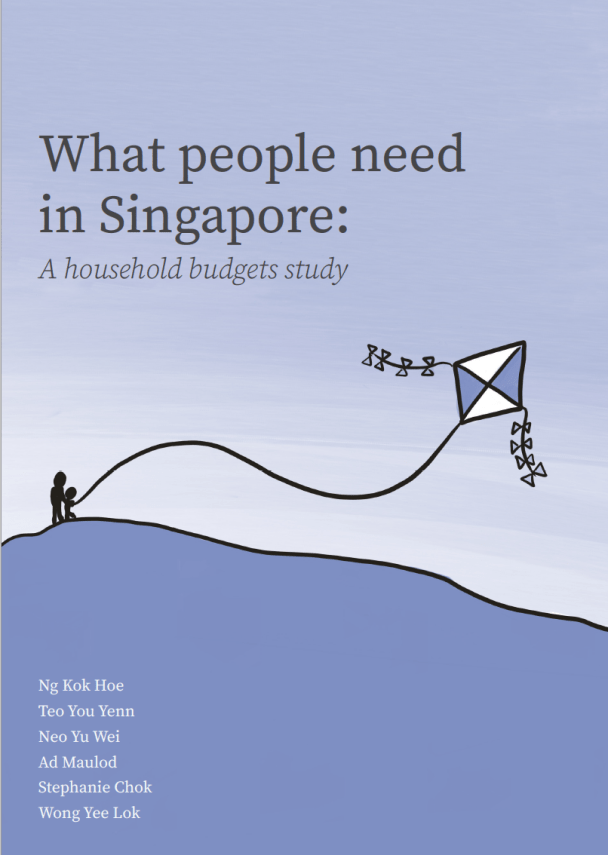
After several years of work, the 2021 Singapore Minimum Income Standard (MIS) report has now been released. The team—consisting of Ng Kok Hoe, Neo Yu Wei, Ad Maulod, Stephanie Chok, Wong Yee Lok and me—ascertained how ordinary Singaporeans think about what constitutes basic needs in Singapore today and determined the household budgets necessary to meet these needs. Our first report, published in 2019, focused on households of elderly people (living alone or as couples). This new report looks at households of parents (single or partnered) living with children aged 25 or below, as well as updating the figures for elderly households.

Following the launch of the report last week, The Straits Times also carried an op-ed (paywall) which I co-wrote with Ng Kok Hoe. In it we explore the nature of the focus group discussions in more detail, highlighting the dynamics of the deliberations and how we observed groups come to consensus despite variations in their own experiences:

Over these four years, we have learnt from our participants that everyone living in Singapore today has needs for housing, food and clothing, opportunities for education, employment and work-life balance, as well as access to healthcare. Everyone needs a sense of belonging, respect, security and independence. Every person needs choices to participate in social activities, and the freedom to engage in one’s cultural and religious practices.

We have learnt from them too that they know not everyone in Singapore today is meeting these needs to the same degree. This does not lead anyone to say that any of these are therefore not needs; that only those who can afford it deserve belonging, respect, security and independence; that some children should have paid tuition suited to their needs and other children will just have to accept whatever they can get from charity.

In spending time and energy to share their experiences and insights with us, our participants have put in our hands the responsibility of putting this question on the table: If ordinary people can see and express that there are universal needs, that there is a baseline below which no one should fall, what will we do collectively to make sure all members of our society meet these basic needs?

Now that we know what a basic standard of living in Singapore should entail, the work ahead must be to ensure that everyone can achieve it.

Find out more about MIS research and the report by visiting the MIS website.

From public sociology to collective knowledge production

I am pleased to share that I have authored a chapter, titled ‘From public sociology to collective knowledge production’, which appears in the recently published The Routledge International Handbook of Public Sociology, edited by Leslie Hossfeld, E. Brooke Kelly and Cassius Hossfeld (Routledge, 2021). In this chapter, I consider my experiences with ‘sociology for a public – engaged in issues members of the public are concerned with, and in dialogue with publics through writings and other forms of communication’. I begin with my training as a graduate student in Berkeley, consider the effects for non-US researchers of an academic field dominated by US sociology, and also raise questions concerning sources of legitimacy of knowledge and the creation of communities for change, in a state which has been dominated by one political party for many decades. 

“…recognizing that academics are typically better analysts than dreamers, the quest to build critical mass and alternative sources of legitimacy are tremendously urgent. To go from analysis of the past and present to alternatives in the future, we need to work with people who know how to dream. The labor of building ideas about alternatives is labor that requires the creativity and expertise of many and cannot be limited to the narrow confines of professional knowledge producers. Moreover, bringing about alternatives that enhance human dignity and well-being requires social solidarity. If the levers of change are indeed to be with ordinary people, shifted away from elites, then these people cannot be a bunch of isolated, atomized individuals. They must know how to see and act as collectives. Even as the building of communities of publics is directed toward specific issues or projects at any given time, they are also essential to the longer-term cultivation of social ties necessary for bringing about significant change.
We are still talking about public sociology in the discipline today – this edited collection still needs to exist – because we as a discipline are still trying to figure out what the hell we are doing existing in this world, doing this work, calling ourselves sociologists. My training at Berkeley means that US sociology lives in my head and infuses my work. Michael has been a major influence in my life, and it is hard to think about public sociology without simply trying to walk behind him. In reflecting on my life after Berkeley, I see anew how bold and important his vision was, how it carved out a path for those of us who came to sociology precisely because we wanted to be part of the world rather than apart from it. I also see, however, that stepping away from Berkeley, living in tension with US sociology, compelled me to turn to a separate lifeworld that may yet hold lessons for sociologists in the United States.
The work of public sociology requires sociologists to position ourselves in a larger ecology of knowledge-producers – we have to find and create communities and bring others in the academy along; we have to stretch across generational divides; we have to do collective knowledge production not only at the point of knowledge dissemination but also at the point of conceptualization and production. The division of labor must go beyond the four quadrants. In a world where our expertise is suspect, we have to build our own communities of legitimacy-granters and create legibility for our work outside the usual anointers of legitimacy. The labor of doing public sociology is collective labor, entailing time to create knowledge and solidarity, involving bodies in and out of the academy. Doing this messy work, I hope we may yet find tools not just for analyzing, but also for dreaming.”


Find out more about the book at the publisher’s website. Read my chapter here.